
Sustainable Development Fund
Funding Criteria & Guidance for Applicants 2025-26
- Important dates
- How the fund works
- How much can you apply for?
- Who can apply?
- What the Sustainable Development Fund funds
- What makes a strong project?
- Introduction to the Sustainable Development Fund
- What is ‘Sustainable Development’?
- Purpose of the Fund
- Essential criteria
- Desirable criteria
- Project Budget
- Decisions
- Project delivery
- Monitoring and Publicity
- Payment of grant
- Links
- How to submit your application
If you need the information on this web page in a different format, please contact us by email at grants@suffolkandessex-NL.org.uk or phone Oka Last, National Landscape Grants Officer on 01473 265558.
1 Important dates
- Closing date for applications to be received: 3rd March 2025
- Project delivery and completion: April 2025 - 12th March 2026
2 How the fund works
- Before you complete the Application Form, it is essential to check that your project benefits the fund area. If your project does not benefit the fund area it will not be eligible to receive a grant (Section 4:2 Geographic eligibility). There are two separate Sustainable Development Funds, one for each designated Area of Outstanding Natural Beauty (now branded and referred to from hereon, as the National Landscape).
- Complete all sections of the Application Form or there may be insufficient information for the Panel to make a fully informed decision on your proposal.
- The National Landscape will acknowledge receipt of the application, inform you of when the Panel will meet and contact you after the Panel Meeting to inform you of the outcome.
3 How much can you apply for?
3.1: There is formally no limit on the amount to be applied for per application. The panel usually award up to £5,000 per project although in exceptional circumstances higher awards may be made.
3.2: Grants are awarded for up to 70% of overall project costs, which may include ‘in kind’ contributions. For example, the value of volunteer time spent working on the project may be costed into the budget. Up to 20% of the project value may be grant support of overhead costs e.g. staff and office costs. See Project Budget Section 12 for more.
4 Who can apply?
4.1: The Fund is open to organisations and groups from the public, private or voluntary sectors. Whilst applications from individuals are not precluded, there needs to be wider public benefit and it is expected that in most cases applications will be submitted on behalf of organisations, groups of people or partnerships.
4.2: There are two separate Sustainable Development Funds, one for each National Landscape:
- Suffolk & Essex Coast & Heaths National Landscape Sustainable Development Fund
- Dedham Vale National Landscape Sustainable Development Fund
Geographic Eligibility
The geographic area of each Fund is the entire geographic area of each National Landscape. You may view the geographic areas of each National Landscape (see Google Maps green shaded areas). Projects need not necessarily come from, or be based in, the National Landscapes.
However, projects must meet the Criteria of the Fund to further the conservation and enhancement of the National Landscape. An award may be made to a project located outside of the National Landscape where benefit is seen to be achieved for/within the National Landscape, for example (but not limited to) projects that benefits transient wildlife or enhances landscape views from the National Landscape.
5 What the Sustainable Development Fund funds
The Fund supports a wide range of costs, essentially, everything that is needed to complete (or develop) a project, that falls within the criteria of the grant, may be funded. The following list is not all encompassing but gives examples of what costs the SDF may support: capital works, practical work, events, activities, training, equipment, materials, technology, interpretation, planting, publicity, contract work, professional services or staff time.
6 What makes a strong project?
Please see both National Landscape websites for summaries of past funded projects and to read case studies. Successful applications clearly demonstrate benefits to the National Landscape and strongly meet the Criteria of the Fund. Recommended reading about the vision of National Landscapes may be found in Links Section 17.
7 Introduction to the Sustainable Development Fund
7.1: As part of the Government’s financial support for National Landscapes the local governing Combined Joint Advisory Committee has made available a proportion to
support the Sustainable Development Fund. In 2025-26 the Dedham Vale National Landscape has a fund of up to £30,000 to distribute. In 2025-26 the Suffolk & Essex Coast & Heaths National Landscape has a fund of up to £40,000 to distribute.
7.2: The purpose of the Fund is to enable local communities and other organisations to make a difference in National Landscapes by promoting and achieving sustainable development. These projects should focus on integrating the environment, local communities and the economy so that these unique areas are conserved and their natural beauty enhanced, making them more enjoyable for all, and reflect that sustainable development is central to the Government’s approach.
7.3: The Government commissioned Landscapes Review of Areas of Outstanding Natural Beauty (AONBs) and National Parks (2019) identified the need to engage with a broader range of society in delivering AONB purpose. The National Landscapes are committed to equality of opportunities to access the Sustainable Development Fund and seek to attract applications from the widest range of society possible.
7.4: Projects funded by the Sustainable Development Fund will share the vision for a sustainable future, as summarised in each National Landscape Management Plan and pledged in The Colchester Declaration in 2019 by the National Association for AONBs (now branded and referred to as the National Landscapes Association).
8 What is ‘Sustainable Development’?
8.1: There have been many definitions of sustainable development. The Bruntland Commission - the 1987 World Commission on Environment and Development - defined it as ‘development that meets the needs of the present generation without compromising the ability of future generations to meet their own needs’.
8.2: The Sustainable Development Fund reflects the Department of Environment Food and Rural Affairs’ (Defra) objectives of sustainable development, partnership and social inclusion. It will aid the achievement of National Landscape objectives by encouraging individuals, community groups and businesses to co-operate in developing practical sustainable and local projects. Defra has stated that they would wish the scheme to ‘develop and test new ways of achieving more sustainable ways of living in countryside of great natural beauty and diversity, which enhance and conserve local culture, wildlife, landscape, land use and community’.
9 Purpose of the Fund
9.1: The purpose of the Fund is to support the statutory purpose of National Landscapes: To conserve and enhance natural beauty.
Supplementary (non-statutory) purposes to National Landscape designation were developed in the 1990s and are:
- Recreation (‘the demand for recreation should be met insofar as this is consistent with the conservation of natural beauty’)
- Socio-economic (‘account should be taken of the needs of agriculture, forestry, other rural industries, and the economic and social needs of local communities’)
- Sustainable development (‘particular regard should be paid to promoting sustainable forms of social and economic development that in themselves conserve and enhance the environment’)
9.2: The objectives and priorities for the National Landscape’s are expressed through the individual National Landscape Management Plans. See Links Section 17 for more.
10 Essential Criteria
10.1: Applicants must demonstrate that their project helps to meet National Landscape objectives and the three sustainable development objectives. :
Does your proposed project help conserve or enhance the natural beauty of the National Landscape and the Sustainable Development Fund area?
Economic sustainability:
Does it help the local economy in some way?
Does it generate its own income?
Does it attract other contributions?
Does it generate new or safeguard existing employment?
Social sustainability:
Does it develop community infrastructure?
Does it provide training or build community capacity to tackle things?
Does it provide new or improved local services?Does it allow/ improve access for a wide spectrum of society?
Does it have support or involvement of local communities?
Environmental sustainability:
Does it help biodiversity and/or sustain distinctive landscapes?
Does it protect natural resources?
Involve reducing, recycling, or reusing materials?
Does it minimise adverse transport aspects?
10.2: Whilst the project does not have to bring equal benefit to all strands, there should be an element of help for each aspect, or certainly no adverse impact. Sustainable development is about the wise use of resources and avoids the exploitation of one strand to the detriment of the others.
11 Desirable Criteria
11.1: A key aim of the scheme is to change the attitude and behaviour of individuals and communities in ways that enhance understanding of sustainable development and the objectives of the National Landscape while promoting co-operation and social inclusion. Preference will therefore be given to projects that cover some or all of the following:
- Demonstration of innovation or best practice
- Promotion of or help implement social inclusion
- Actively involve members of the community
- Provide benefit to the public and wellbeing
- Involvement or encouragement of partnership working
- Complementary to key local and national strategies
- Involvement of young people and/or other groups underrepresented in the National Landscape
- Has little or no access to alternative funding sources
- Lever in contributions from other sources
- Provide potential PR for project and the National Landscape
11.2: National Landscape Priorities - The National Landscape is particularly keen to encourage projects that are pertinent to its key priorities. Preference will therefore be given to projects that cover some or all of the following:
- Enhances landscape character
- Education for sustainable development
- Sustainable access and recreation
- Sustainable tourism
- Sustainable transport
- Local product promotion/development
- Enhances biodiversity
- Working with communities at grassroots level to increase awareness of, support for and participation in the care of the National Landscape
- Addresses impacts and causes of climate change
11.3: This is not a comprehensive list and other activities could qualify for grant aid.
12 Project budget
12.1: A case can be made with the application, or exceptionally when returning the acceptance of the grant offer, for money to be released up front – i.e. before the project is started. This is to help with issues of cash flow for smaller organisations and is unlikely to be more than 50% of the grant offer. It is usual that all grants are paid in arrears.
What the applicant contributes
12.2: The Fund will take applications for up to 70% of a project value. Where projects are seeking a grant of up to £500, organisations can apply for 100% of the total costs. Eligibility of grant support for covering overheads: Up to 20% of the project value may be grant support of overhead costs e.g. staff and office costs. Panels usually expect to fund project activity. Panels recognise that projects need resources to deliver them. Panels anticipate seeing overhead costs, such as staff and office costs as part of match funding, so showing up in the income and expenditure elements of the budget. In most cases the Panel will consider supporting staff and office costs at 20% of expenditure levels. (i.e. up to 20% of the overall value of the project). In some circumstances, for example where staff are brought in to deliver a particular project the intervention rate may rise to 100% of overhead costs.
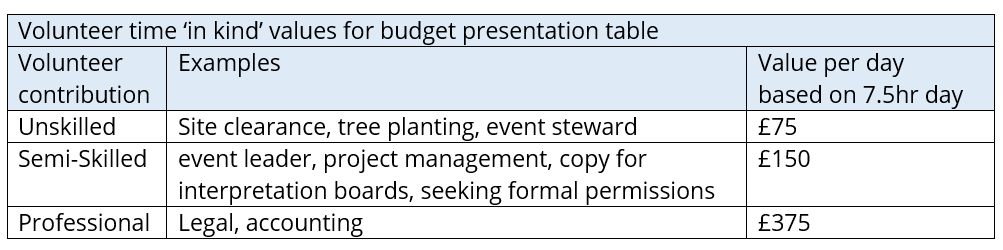
12.3: Voluntary and community organisations may be able to use ‘in kind’ help (e.g. volunteer time or the loan of equipment, premises or land) to form at least part of their matching contribution. The Applicant should calculate ‘in kind’ contributions and include in the project budget for the Panel to be fully informed in the
decision making process.
VAT
12.4 : If the application is from non VAT registered organisation/body/individual the SDF can fund up to 70% of the gross cost of the project. (i.e. VAT cost can be met by the fund). If the application is from a VAT registered organisation the SDF cannot meet any VAT costs (i.e. use figures excluding VAT).
Budget presentation
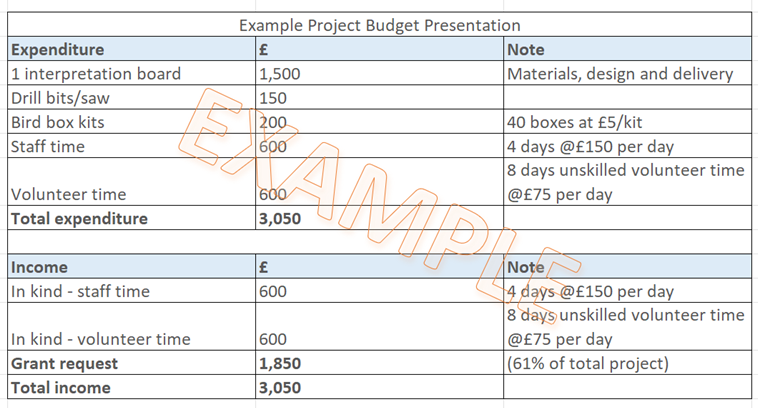
12.5: It is vital for the Grant Advisory Panel to see the financial details of your project. Please include in your application a detailed breakdown of the expenditure and income of the project. It is important for the Panel to see how the money is likely to be spent. The Panel appreciates that some elements may be hard to cost but it is important that expenditure is not presented under large general headings or that guesses are made about costs. This is to everyone’s benefit as it would be sad to find there is not enough money to complete the project when the Panel would have been willing to offer more grant aid to a well thought out application. If estimates must be made, please indicate this on the form.
12.6: Below is an example of a table that is useful for the Panel to consider your application. It is a requirement for your budget presentation to be in a similar format, for consistency of information that is presented to the Panel across all applications.
13 Decisions
Pre-panel assessment
13.1: Applications will be acknowledged within five working days, and applicants will be informed of the date on which the Panel will consider their application.
13.2: Applicants may in some instances be asked to provide further information to allow a decision to be taken. It is the responsibility of the applicants, not the National Landscape Team, to ensure that they have supplied all the required information.
Panel assessment
13.3: Applications will be considered by the Sustainable Development Fund Panel which includes a member of both Suffolk & Essex Coast & Heaths, and Dedham Vale National Landscape Combined Joint Advisory Committee. Representatives can include those reflecting particular interests such as natural heritage, cultural heritage, agriculture, tourism, recreation, education, business, local communities and young people.
Whilst the Panel is authorised to deal with all applications, the scheme is overseen by the respective National Landscape Combined Joint Advisory Committees and they may choose to assume direct responsibility for the administration of some grants. This might arise for example where it appears that eligibility criteria are not being met or where there is a clear risk of financial mismanagement of the project. Any applications that are ‘called in’ will be considered by the Committee and its decision will be final.
The work of the Grant Advisory Panel will be regularly reported to the National Landscape Combined Joint Advisory Committees. A summary of the applications, the decisions made and the outcomes of successful projects will also be reported to Defra to demonstrate the results of the Fund.
13.4: Applications will be assessed by the Grant Advisory Panel. They will look at the above criteria and judge how well the project meets those aspirations. As it is likely that the Fund will be over-subscribed, the Panel will favour projects that really grasp the concept of sustainable development and have demonstrated how they are trying to meet the criteria and priorities of the National Landscape. The Panel may advise that an offer is made for less than the full amount requested. They may also give guidance to the National Landscape Grants Officer to discuss certain aspects of the project with the applicant to clarify details before they give their final advice.
Notification to applicants
13.5: Reasonable efforts will be made to contact applicants by telephone within five working days of the Panel meeting to inform them whether their application has been successful and, if so, the amount of grant they have been awarded. This will be followed up by an e mail with written confirmation and a formal offer of grant aid for successful applicants.
13.6: Following the advice of the Grant Advisory Panel, an offer of grant aid will be made. This will normally include certain conditions which may relate to (but not limited to)
- What the grant aid is supporting
- Accepting the offer of grant and conditions within a certain period
- The evidence required to prove the project has been completed that will need to accompany the claim for the grant aid
14 Project Delivery
14.1: Projects must wait to begin publicity and delivery of the project until the formal offer letter has been received.
14.2: Applicants are responsible for management and delivery of all elements of the project, including payment of project costs and safety. All necessary permissions and procedures for the safe delivery of the project must in place. Your delivery must not conflict with any Government or other statutory body advice.
14.3: Any proposed changes from your original application must be agreed in writing.
14.4: Unless otherwise agreed in writing all projects must be completed by the following March (i.e. grants must be completed by the end of the financial year).
15 Monitoring and Publicity
Monitoring
15.1: Monitoring forms are required and are a necessary part of the feedback to Defra, the regulating body. A mid-year update will be due and details of this will be provided in the formal grant offer letter.
15.2: For the final claim, the National Landscape must receive an End of Grant Monitoring Form and a short Final Report by 12th March 2026 to be emailed to grants@suffolkandessex-NL.org.uk. The Final Report (approx. 1 page) should include general information about the project such as:·
- An overview of achievements, including measures of success
- How SDF conditions were met - outline the main benefits of the project to the National Landscape i.e. landscape, environmental, social, economic and access enhancements.
- Any difficulties encountered/learning points
- Number of people involved (e.g. volunteers/visitors/those using service)·
- Number of events held (if applicable)·
- Any feedback or quotes from participants that the SDF Panel and the National Landscape has permission to use in its own promotions
15.3: The final claim must also include project documentation as follows:·
- An invoice to the National Landscape for the grant payment·
- Evidence to support your final claim such as:
- final project budget summary
- supporting evidence for expenditure e.g. receipts
- evidence of publicity achieved by the project
- at least two electronic photos of the project that the SDF Panel and the National Landscape has permission to use in its own promotions
Acknowledgement and Publicity
15.4: Projects must comply with the Publicity Guidance for Grant Funded Projects. This document provides guidance on:·
- Publicity conditions and expectations of the Sustainable Development Fund
- Acknowledgement of your grant award
- Mandatory use of National Landscape logos
- Proof-reading by the National Landscape Team of project materials/publicity before release
- Use of digital platforms
- Planning and delivery of project communications
- Support available to your project from the National Landscape Team
15.5: The National Landscape reserve the right to use any material submitted for publicity purposes.
16 Payment of Grant
16.1: Grants will normally be paid in arrears/on completion unless alternative arrangements have been made in advance. Requests for interim payments are requested in the Application Form or, in exceptional cases, upon grant acceptance.
16.2: The National Landscape will monitor the progress of projects and may, if required, carry out site inspections. If this monitoring highlights difficulties with the project there may be the need for discussion and negotiation. It is the desired intention to help all projects reach a satisfactory conclusion, but the National Landscape team and Grant Advisory Panel will wish to safeguard the wise and legitimate use of the Fund.
16.3: The payment of the grant will be dependent on the submission of relevant records (e.g. receipted invoices) as detailed in the grant offer letter or agreed in writing subsequently with the applicants. For the avoidance of any doubt, grants may not be paid if the project is not delivered as per the grant offer, including any conditions.
16.4: Payment request is by invoice from the applicant to the named fund. Applicants need to have a bank account for full grant payment to be invoiced from and paid into. If this is not possible, the applicant may request (on the Application Form) to nominate a partner organisation to provide a bank account for project purposes.
16.5: There is a national monitoring programme to oversee the working of the Funds and therefore all projects supported must be ready to provide relevant information and access to the national monitoring team if asked to do so.
17 Links
For more about applying to the SDF and other National Landscape grant giving programmes:
18 How to submit your application
Completed applications (preferably typed, or if not, clearly written in dark ink) should be submitted on the application form by midnight on 3rd March 2025.
Submission by e mail is encouraged: grants@suffolkandessex-NL.org.uk
National Landscape Grants Officer
Sustainable Development Fund
Dedham Vale National Landscape
Saxon House
1 Whittle Road
Hadleigh Road Industrial Estate
Ipswich
Suffolk
IP2 0UH
Tel: 01394 445225